

About permaculture
Natural Progress > About > Permaculture
About permaculture
Permaculture (permanent agriculture) is a design framework developed in the 1970s by two Australians: Bill Mollison and David Holmgren. It facilitates the design and management of productive ecosystems that have the diversity, stability and resilience of natural systems.
Permaculture was a pushback against the trend towards oil-dependent industrial farming. Permaculture is based on working with nature rather than against it, considering all functions of a system, rather than just one aspect.
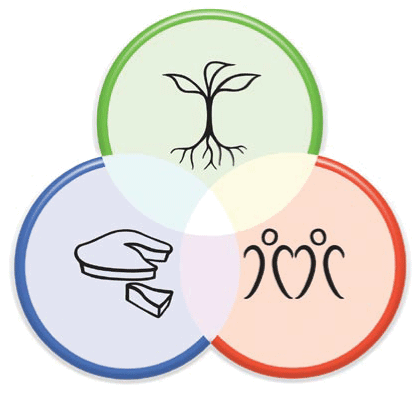
At its heart, permaculture is based on 3 ethics:
- Earth care – caring for all the living and non-living things – including the soil, the air, plants, animals, water. The aim is to enhance and preserve rather than deplete or degrade.
- People care – making sure our basic needs for food, shelter, education, employment and healthy social relationships are met. This is about promoting self-reliance and community responsibility so that we look out for one another.
- Fair share – reducing our consumption and increasing the creation and redistribution of surpluses. Surpluses result from successful designs in which abundance is shared with the community or returned to the earth as animal feed or compost.
Permaculture was influenced by the practices of indigenous subsistence farmers across the world, who have long used sustainable methods to grow their crops. Farmers would typically plant diverse sets of crops, using perennial species to form productive stable systems, and prioritise the regeneration of soil. This is a very different approach to modern industrial agriculture based on annual, monoculture crops that deplete the soil and require chemical fertilisers.
Permaculture shares aspects of regenerative agriculture – though it’s probably fair to say permaculture is more holistic in its approach, covering aspects such as the social context, and even extending into community, political and financial systems.
More about us
The 12 permaculture principles

1. Observe and interact
Take time to study nature and notice what is happening before making changes.

2. Catch and store energy
Capture and save resources (such as solar power, rainwater, or organic matter) during periods of abundance.

3. Obtain a yield
Ensure your design produces a tangible, useful output or benefit (like food, fiber, or energy).

4. Apply self-regulation and accept feedback
Learn from mistakes, listen to system feedback, and adjust behavior or design accordingly.

5. Use and value renewable resources and services
Rely on natural abundance and cycles rather than depleting non-renewable goods.

6. Produce no waste
Find ways to reuse, recycle, or repurpose every output so nothing goes to waste.

7. Design from patterns to details
Step back to observe broad patterns in nature and society before diving into fine-tuning specifics.

8. Integrate rather than segregate
Place elements so they support each other (e.g., combining chickens and orchards to manage pests and fertilize soil).

9. Use small and slow solutions
Start simple and scale at a manageable pace; local, small-scale systems are easier to maintain and more resilient.

10. Use and value diversity
Introduce variety in plants, animals, and functions to increase resilience against pests and climate shifts.

11. Use edges and value the marginal
Look to boundaries and transition zones (like the edge of a pond or forest), where unique and productive interactions happen.

12. Creatively use and respond to change
Anticipate and adapt to shifting conditions in a deliberate, measured way
The short videos below recall how permaculture started.
